

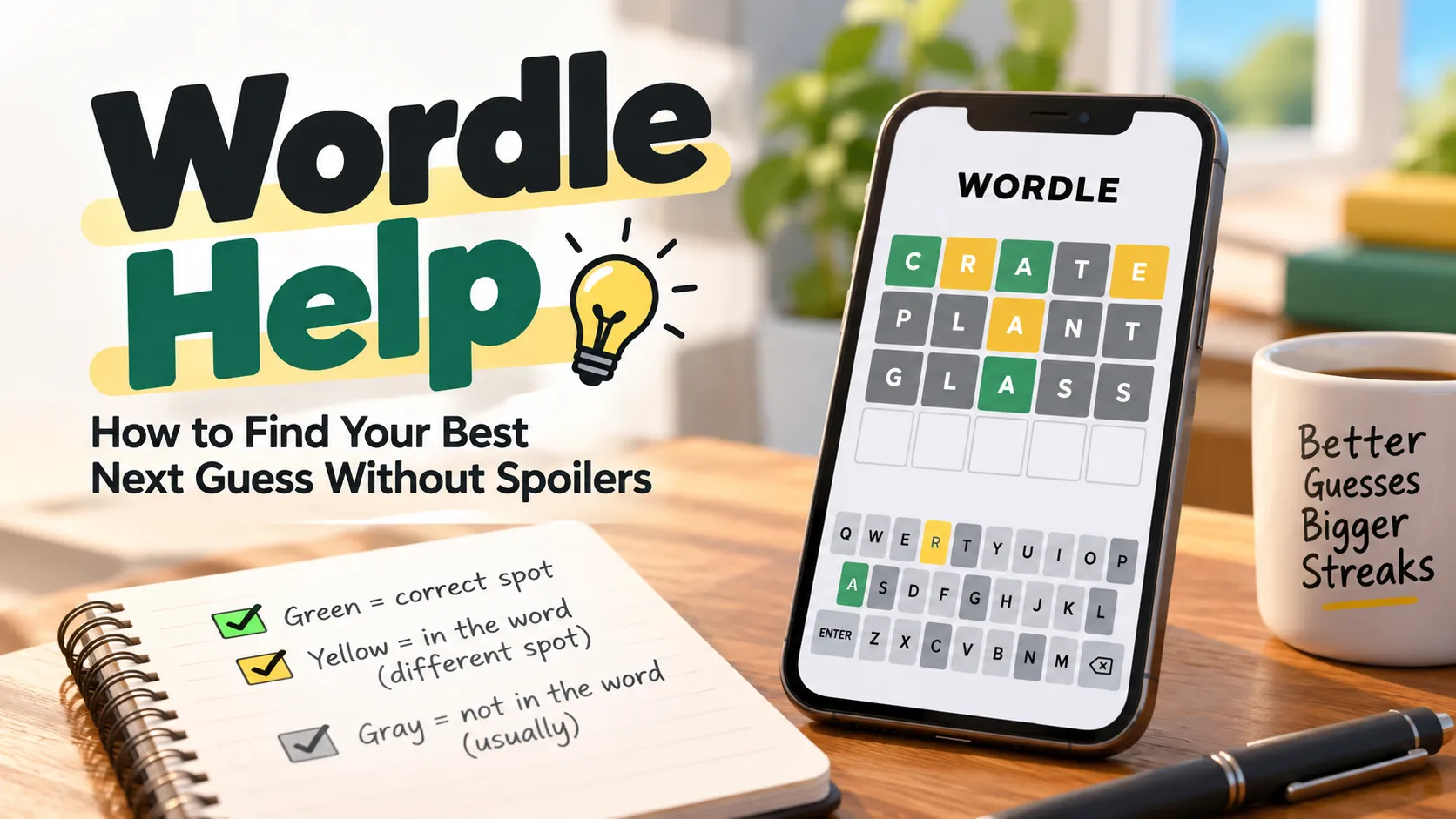
Stuck on Wordle and not sure what to try next? Good Wordle help should not spoil the puzzle before you are ready. It should help you use the green, yellow, and gray letters already on your board to make a smarter next guess.
The key is simple: do not just look for a word that fits. Look for a guess that either solves the puzzle or gives you useful new information.
Here is how to narrow your choices, avoid common Wordle traps, and find your best next guess without jumping straight to the answer.
Start With What Your Wordle Board Already Tells You
Before searching through possible Wordle words, read your board carefully.
A green tile means the letter is correct and in the right position. A yellow tile means the letter is in the answer but belongs somewhere else. A gray tile normally means that letter is not needed, although repeated letters can make gray tiles a little more complicated.
Imagine you know that A is green in position two, R is yellow, and S, T, and L have been ruled out.
You are no longer looking for any random five-letter word. Your next guess needs A in the second position, R somewhere other than the position where it turned yellow, and no S, T, or L.
It sounds simple, but this is where many guesses go wrong. Players often focus so much on their green letters that they forget yellow letters also give position information.
How to Choose Your Best Next Wordle Guess
When you are stuck, your next guess can do one of two jobs.
It can try to solve the puzzle, or it can collect information that makes the answer easier to find on the following turn.
Those two goals are not always the same.
Suppose your board gives you a pattern like:
_ A _ E _
Several words may fit. Picking one at random can work, but it can also burn a valuable guess.
Sometimes the better move is a word that tests the letters separating those possible answers.
Early Guesses Should Give You Information
On guesses two and three, you usually have enough room to explore.
If your opening word gives you only one useful letter, there is little value in filling your next guess with letters that have already turned gray.
Try to test several useful new letters instead.
For example, if your first guess has already tested A, E, R, S, and T, your next word may be more useful if it checks letters such as C, L, N, I, or O.
You also do not always need to force every known letter into your next guess in normal play. Sometimes a testing word gives you more information than a word that looks like a possible answer.
Late Guesses Need a Different Strategy
Your thinking should change around guesses four, five, and six.
At that point, you normally have enough information to focus on realistic answer candidates.
If you are on guess five with three green letters, do not enter the first word that comes to mind. Check the whole board again.
Make sure your yellow letters have moved to legal positions. Check every gray letter. Think about repeated letters. Most importantly, look for several words that may share the same pattern.
That short check can prevent an avoidable loss.
Watch Out for Wordle Word Traps
One of the hardest situations in Wordle happens when you know most of the word but many answers still fit.
Imagine this pattern:
_ATCH
You might think of BATCH, CATCH, HATCH, LATCH, MATCH, PATCH, and WATCH.
Guessing them one at a time is risky because each failed guess tells you very little about the others.
This is a classic Wordle trap.
Instead of asking, “Which answer should I gamble on?” ask:
“Which guess can eliminate the most possibilities?”
A useful probe word can sometimes test several of the missing starting letters at once.
The same problem can happen with patterns such as _IGHT or _OUND. Whenever several words differ by only one letter, stop before guessing through the whole family.
This is where smart Wordle help is much more useful than a simple list of matching words.
Use Yellow Letters Properly
Yellow letters are more powerful than they first appear.
If R turns yellow in position three, you now know two things: R must be in the word, and R cannot be in position three.
If R turns yellow again when you try it in position four, you have ruled out another place.
That means a yellow tile is not just telling you which letter to use. It is also helping you map where that letter cannot go.
When using a Wordle helper or Wordle solver, make sure it accounts for the positions of yellow letters. A tool that only asks which letters are present can return words that your board has already ruled out.
Be Careful With Duplicate Letters
Repeated letters are one of the easiest Wordle rules to misread.
Suppose you guess a word with two E’s. One E turns yellow while the second turns gray.
That does not mean E is absent from the answer.
Instead, the result may mean the answer contains only one E.
The same issue can happen when one copy of a repeated letter turns green and another turns gray. Wordle is telling you something about both the position and the number of times that letter appears.
When duplicate letters are involved, do not treat every gray tile as a simple ban.
Ask yourself:
How many copies of this letter does the board actually support?
This small detail can make the difference between a useful Wordle next guess and a word that was already impossible.
Possible Wordle Words Are Not Always the Best Guesses
A useful Wordle guess does not always have to be a likely answer.
This distinction matters.
A possible answer fits everything you currently know.
A strategy guess may be another valid word chosen because it tests important letters.
Imagine five possible answers remain. Each fits your green and yellow tiles, but they differ in several uncertain letters.
You could guess one of the five and hope.
Or, if you have enough turns left, you could use another word that tests several of those uncertain letters together.
The second option may give you a much clearer path to the answer.
That is why the most useful Wordle helper should separate possible answers from best next guesses.
A list of 30 matching words is not much help if you still do not know which word to play.
Choose How Much Wordle Help You Want
Not everyone searching for a Wordle hint wants the answer revealed.
A good way to keep the puzzle fun is to increase the amount of help slowly.
Start with a broad clue. You might check whether the word has more than one vowel, contains a repeated letter, or uses one of your yellow letters near the end.
If that is not enough, move to a next-guess suggestion. Look for a word that keeps your greens, moves your yellows, avoids confirmed gray letters, and tests useful new letters.
Still stuck? Narrow the board to a small group of possible Wordle words.
Only reveal the direct answer when you actually want the puzzle spoiled.
You can play the live puzzle through the official New York Times Wordle game.
This gradual approach gives you help while still letting you do most of the solving yourself.
Wordle Hard Mode Help
Hard Mode changes which strategies you can use.
In normal play, you may choose a probe word that ignores one of your known letters because you want to test several new ones.
Hard Mode gives you less freedom because revealed hints must be used in later guesses.
If A is green, you need to keep it in that position. If R is known to be in the word, your next guess needs to use R.
This can make word-family traps more dangerous.
When several answers still fit in Hard Mode, look for a legal guess that follows every known clue while testing as many uncertain letters as possible.
A Wordle solver with a Hard Mode option should follow these limits rather than recommending guesses that the game will not accept under those rules.
Common Wordle Mistakes When You Are Stuck
A few mistakes cause many late-game problems.
Reusing a clearly gray letter wastes space that could test something new. Putting a yellow letter back into a position where it was already yellow ignores useful information. Assuming an answer cannot contain repeated letters can also remove the correct word from your thinking.
Another common mistake is guessing similar answers one after another.
If several words share almost the same pattern, do not depend on luck if another guess can separate them.
Also be careful with very obscure words. A word may be accepted as a valid guess without being the most sensible answer candidate. When you are close to solving the puzzle, common and natural possibilities usually deserve your attention first.
Quick Wordle Help Checklist
When you cannot see your next move, use this simple check:
- Lock every green letter into its correct position.
- List each yellow letter and the positions where it cannot go.
- Remove letters that have clearly been ruled out.
- Check whether repeated letters could explain an unusual tile result.
- Find the realistic words that still match every clue.
- If many answers remain, look for a guess that tests their differences.
- If only a few remain, compare the actual answer candidates carefully.
- Reveal a stronger hint only when you need more help.
The best Wordle help does not have to give you the answer.
Most of the time, one smart next guess is enough. Keep your greens, move your yellows, respect the grays, watch for duplicate letters, and avoid guessing blindly when several words share the same pattern.
Use every tile as evidence, and your next move becomes much easier to see.

1 Comment
Pingback: Wordle Clue Today: Helpful Hints Without Spoilers