

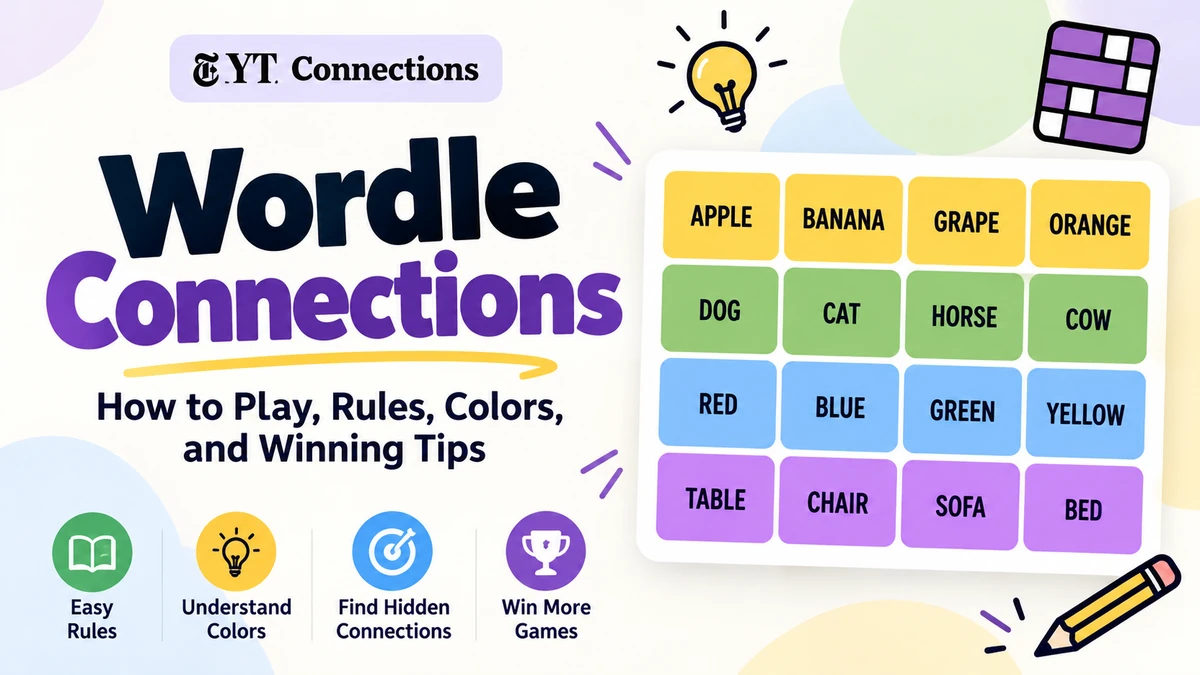
If you enjoy word puzzles, you may have heard of Wordle Connections. Many people use this name when searching for NYT Connections, a popular daily word game from The New York Times. Although Wordle and Connections come from the same publisher, they are two different games.
In Connections, you get 16 words and must divide them into four groups of four. Each group shares something in common. It could be a similar meaning, a familiar phrase, or a hidden word pattern. Some connections are easy to spot, while others require a little more thought.
The good news is that you don’t need to be a word expert to enjoy the game. Once you understand the rules and learn a few useful strategies, finding those hidden groups becomes much easier.
What Is Wordle Connections?
Wordle Connections is a common search term for NYT Connections, a daily word puzzle that challenges players to find relationships between different words.
The game displays 16 words in a 4×4 grid. Your goal is to organize them into four groups, with exactly four words in each group. Every group has a specific connection that you must discover.
For example, if you see APPLE, BANANA, GRAPE, and ORANGE, you can quickly recognize that all four are fruits. However, real Connections puzzles are usually more challenging. Some words have several meanings, while others may appear to belong to more than one category.
Unlike Wordle, where you guess a hidden five-letter word, Connections tests your ability to recognize meanings, patterns, and word relationships.
You can play the daily puzzle on the official New York Times Connections website.
How to Play Wordle Connections
The rules of Connections are simple, even if you have never played before. When you open the game, you will see 16 words arranged in a grid. Your task is to select four words that share a common connection and submit them as a group.
If your selection is correct, those words move into a colored row, and you continue solving the remaining groups. If your selection is wrong, the game counts it as a mistake.
You can make up to three incorrect guesses and still win. Your fourth incorrect guess ends the game.
To play, follow these steps:
- Read all 16 words carefully.
- Look for four words that share something in common.
- Select those four words.
- Press Submit to check your guess.
- Continue until you find all four groups.
One helpful habit is to study the entire board before making your first guess. The first connection you notice might not be the intended one.
For example, imagine a practice puzzle containing RED, DOG, BLUE, CAT, GREEN, HORSE, YELLOW, and COW. At first, these words appear mixed together. However, RED, BLUE, GREEN, and YELLOW belong to the color category, while DOG, CAT, HORSE, and COW are animals.
That is the basic idea behind Connections. Real puzzles use more creative relationships, so you need to think carefully before submitting a group.
What Do the Colors Mean in NYT Connections?
Connections uses four colors to show how difficult each category is: yellow, green, blue, and purple. Understanding these colors can help you recognize the kinds of challenges the puzzle includes.
Yellow is the easiest category. It usually contains words with a clear connection, such as similar meanings or familiar objects.
Green is slightly harder. The words may still be related in a familiar way, but the connection can take more time to recognize.
Blue is more challenging. These groups may require specific knowledge or a less obvious relationship between words.
Purple is the trickiest category. It often involves clever wordplay, unusual meanings, or hidden patterns that are difficult to notice immediately.
You do not have to solve these categories in order. You can find the purple group first or solve the yellow group last. The colors appear after you submit a correct group, so they do not give away the difficulty of the words while you are playing.
Why Is the Purple Category So Difficult?
Purple groups often require you to think beyond the everyday meaning of a word.
Imagine you see BUTTER, DRAGON, HOUSE, and HORSE. These words seem unrelated at first. However, when you add the word “fly” after each one, you get butterfly, dragonfly, housefly, and horsefly.
Suddenly, the connection makes sense.
This is a practice example rather than an answer from today’s puzzle. It shows how Connections can hide relationships through word combinations.
When ordinary meanings do not help, try adding the same word before or after each clue. Sometimes the answer is hidden in how the words are formed rather than what they mean.
What Does “One Away” Mean in Connections?
One of the most useful messages in the game is “One Away.” You will see this when three of your four selected words belong to the same correct group, but the fourth word does not.
For example, suppose you choose four words that you believe are types of trees. If the game shows “One Away,” it means three of your selected words belong together in one of the puzzle’s correct categories.
However, the game does not tell you which word is wrong.
Instead of making another quick guess, examine the remaining words and look for a possible replacement. Ask yourself which selected word has the weakest connection to the other three.
Avoid randomly swapping words because every incorrect guess brings you closer to losing. A careful review often works better than guessing.
Common Types of Word Connections
Connections becomes easier when you understand the different ways words can be related. Not every category involves simple topics like animals, food, or colors. Some groups depend on meanings, phrases, or unusual word patterns.
Words With Similar Meanings
Some groups contain synonyms, which are words with the same or nearly the same meaning.
For example, HAPPY, GLAD, JOYFUL, and CHEERFUL all describe a positive feeling.
These connections are usually easier to recognize because the words share a familiar meaning.
Words That Complete a Phrase
Other groups contain words that can be combined with another word to form common expressions or compound words.
For example, BALL, MAN, FLAKE, and STORM can all follow the word “snow.” They become snowball, snowman, snowflake, and snowstorm.
When a group seems difficult, try adding a common word before or after each clue.
Words With Multiple Meanings
English has many words with more than one meaning. The word “bat” can describe a flying animal or equipment used in baseball. Similarly, “bank” can refer to a financial institution or the side of a river.
Connections often uses these different meanings to confuse players.
If a word does not seem to fit, consider whether another meaning creates a stronger connection.
Hidden Word Patterns
Some Connections categories depend on spelling, sounds, abbreviations, or familiar expressions rather than word meanings.
These groups can be difficult because the relationship is not obvious. Looking for shared beginnings, endings, or similar sounds may help you discover the pattern.
7 Simple Strategies to Win More Connections Games
Winning Connections is not only about knowing lots of words. It is also about thinking carefully, recognizing misleading clues, and making good decisions.
1. Read Every Word Before Guessing
It can be tempting to select four related words immediately. However, another word on the board might fit the same category.
Reading all 16 words first helps you notice possible traps and avoid mistakes.
2. Start With the Strongest Connection
Look for a group where all four words clearly belong together. A specific connection, such as four musical instruments, is usually safer than a loose relationship based on similar ideas.
Solving a clear group also makes the remaining board easier to study.
3. Watch for Misleading Words
Connections often includes red herrings. These are words that appear to belong in one category but actually fit another group.
For example, five words might seem related to sports, even though only four form the intended category.
Before submitting a guess, check whether one word has a stronger connection elsewhere.
4. Think Beyond the First Meaning
Words such as spring, match, date, and light can have several meanings.
If a word seems confusing, try thinking about different ways it could be used. Sometimes the correct group becomes clear when you stop focusing on the most obvious meaning.
5. Avoid Random Guessing
You only have four mistakes available, so guessing without a strong reason can end your game quickly.
If you are unsure about a group, continue studying the board instead of testing random combinations.
6. Use the Remaining Words as Clues
Every correct group removes four words from the unsolved grid. This makes the remaining connections easier to recognize.
After completing a group, review the words again. A connection that seemed difficult earlier may now become obvious.
7. Take a Break When You’re Stuck
Sometimes staring at the same words for several minutes makes it harder to notice a new connection.
Taking a short break can help you return with a fresh perspective. This is especially helpful when you keep thinking about the same incorrect group.
Wordle vs. Connections: What’s the Difference?
Although people often search for “Connections Wordle,” the two games have different goals and rules.
In NYT Wordle, your task is to guess a hidden five-letter word within six attempts. After each guess, colored tiles show which letters are correct and whether they are in the right positions.
Connections works differently. Instead of guessing one word, you must find four groups of related words among 16 choices.
The games also use colors in different ways. In Wordle, green, yellow, and gray tiles provide feedback about letters. In Connections, yellow, green, blue, and purple represent the difficulty of completed categories.
Wordle focuses on spelling, letter placement, and deduction. Connections focuses on vocabulary, word meanings, and hidden relationships.
Both games reward careful thinking, but Connections encourages you to explore several possible meanings before making a choice.
Wordle Connections Today: How to Find Helpful Hints
Some Connections puzzles feel easy, while others can leave you stuck on just one group.
When this happens, a useful hint can help without revealing the full answer.
The best approach is to start with a small clue and only look for stronger hints if you still cannot solve the group.
For example, a gentle hint might tell you that a category involves food, movies, or objects found in a kitchen. A stronger hint might explain that the words share a common ending or can all follow another word.
A more revealing clue could give you the category name, while the complete answer would show all four words.
If you want to enjoy solving the puzzle yourself, avoid checking full answers too early.
When searching for Wordle Connections hints today, look for pages that separate general clues from category hints and complete solutions. This allows you to choose how much help you need without spoiling the entire puzzle.
Can You Play Wordle Connections Unlimited?
The official NYT Connections game offers one new puzzle each day. However, you may want to keep playing after finishing the daily challenge.
Several third-party websites offer Connections-style games with unlimited rounds. These versions can help you practice finding word relationships and recognizing hidden patterns.
However, unofficial unlimited games are not the same as the original New York Times puzzle. Their rules, categories, and difficulty may vary.
If you prefer official puzzles, The New York Times also provides a Connections archive for eligible subscribers.
According to the official NYT Connections Help Center, eligible subscribers can access previous puzzles dating back to June 2023.
Playing older puzzles can help you become more familiar with the different types of categories used in Connections.
Frequently Asked Questions About Wordle Connections
Is Wordle Connections Free?
Yes. The official daily NYT Connections puzzle is free to play. Some extra features, including the archive, require an eligible New York Times subscription.
What Time Does NYT Connections Reset?
A new Connections puzzle becomes available at midnight in your local time zone. This means you can start a fresh puzzle every day.
Is Connections Harder Than Wordle?
It depends on your strengths. Wordle may feel easier if you enjoy spelling and letter patterns, while Connections may suit you better if you enjoy vocabulary, word meanings, and wordplay.
Can You Play Connections More Than Once a Day?
The official game offers one new puzzle each day. Eligible subscribers can also play older puzzles through the Connections archive. Unofficial unlimited versions provide additional practice.
What Happens If You Make Four Mistakes?
Your game ends after your fourth incorrect guess. The correct groups are then revealed, allowing you to see the connections you missed.
Can You Play Wordle Connections on Your Phone?
Yes. NYT Connections works on smartphones, tablets, and computers. You can play through a web browser or the New York Times Games app.
Final Thoughts
Wordle Connections is an enjoyable way to challenge your thinking and discover surprising relationships between words. The rules are simple, but finding the right groups takes patience, creativity, and practice.
The best approach is to read every word carefully, start with the strongest connections, and avoid wasting guesses on groups you are unsure about.
As you become more familiar with hidden meanings, word patterns, and misleading clues, even difficult puzzles will start to feel more manageable.
And remember, you do not need to solve every group immediately. Sometimes a small hint or a fresh look at the board is all you need to find the missing connection.

1 Comment
Pingback: Wordle Word Tips: Best Words & Winning Strategies